The GT+ comes with a full touring package, branded side cases, thoughtful ergonomics and modern electronics, putting it on a par with its European premium competitors. On the highway, it offers absolute stability, in corners — scalpel-like precision, and in the city — the same Japanese reliability that generations of motorcyclists love Suzuki for.
Next, we move on to a detailed analysis of how the GSX-S1000GT+ combines a sports bike soul, technological intelligence and touring practicality without compromise.
Contents
- Design
- Chassis and Handling
- Electronics and Safety
- Engine and Transmission
- Fule Consuption
- Ride Experience
- Pricing
- Competitors
- FAQ
DESIGN
Front end
The 2025 Suzuki GSX-S1000GT+ review begins with the front end, which literally ‘cuts through’ the air with its wedge-shaped fairing and signature vertically positioned LED headlights. This design is not just visually aggressive — it is based on the GSX-R sports bike, and every angle has an aerodynamic purpose. With a total length of 2,150 mm, the bike looks elongated and stable, creating a feeling of confidence even at high speeds.
The tall windscreen has been harmoniously integrated into the front end by the designer, forming a total height of 1,350 mm and providing serious protection from oncoming airflow. Combined with a width of 925 mm, this creates a feeling of volume. All this not only adds to the aesthetics, but also forms a key feature of the GT+: aggression without losing functionality.
Side view
The GSX-S1000GT+ profile is a symbiosis of a sporty, muscular silhouette and a refined touring balance. The long wheelbase of 1,470 mm is the gold standard for stability in the Sport-Tourer class: the bike is stable at speed but retains its agility in corners. Visible through the open panels, the inline four-cylinder engine borrowed from the GSX-R1000 visually shapes the side of the bike: the engine is not only the metal heart, but also the aesthetic dominant.
The seat height of 845 mm provides an active but not overly aggressive riding position. This is the ideal point for controlling the front axle, but shorter riders will need to get used to it. Despite its curb weight of 232 kg, the bike does not feel heavy: thanks to its low centre of gravity and clever weight distribution, the GT+ responds precisely and predictably. In motion, it feels much lighter than the dry figures suggest — credit to Suzuki's engineers, who have perfected the balance between the chassis and the engine.
Rear
The rear of the GSX-S1000GT+ demonstrates Suzuki's ability to combine style and practicality. The GT+ side cases are so seamlessly integrated that they look like part of the fairing rather than an afterthought. Their shape precisely follows the lines of the body, maintaining sporty proportions even when loaded. It is important to note that the total width of 925 mm is measured without the panniers — with them, the bike remains within the reasonable limits of a touring bike without losing its manoeuvrability in the city.
The 155 mm ground clearance clearly indicates that this is a true road Sport-Tourer, not an adventure bike. This clearance is sufficient to confidently navigate slopes or park on uneven surfaces, but the emphasis remains on asphalt. The rear light is a compact LED unit that stylistically continues the lines of the tail, creating a feeling of lightness. Thanks to the sloping geometry of the tail fairing, the bike looks ready to go — and this is the true signature of GT+: aggressive sports bike styling adapted for the open road.
Visually, all this is emphasised by the signature Pearl Matte Shadow Green colour — a deep matte green-grey shade that embodies technical precision and restrained power. This colour does not scream — it hints at the maturity, confidence and character of Japanese engineering, where every element has a functional justification.
| Dimension | Value |
|---|---|
| Overall Length | 2140 mm (84.3 in.) |
| Overall Width | 825 mm (32.5 in.) *Dimension excludes mounted side cases |
| Overall Height | 1215 mm (47.8 in.) |
| Wheelbase | 1460 mm (57.5 in.) |
| Seat Height | 810 mm (31.9 in.) |
| Ground Clearance | 140 mm (5.5 in.) |
| Curb Weight | 226 kg (498 lb.) *Dimension excludes mounted side cases |
| Headlight | Dual LED |
| Color | Pearl Vigor Blue (YKY) -or- Metallic Oort Gray No.3 (QEB) |
CHASSIS and HANDLING
Suspension
The 2025 Suzuki GSX-S1000GT+ demonstrates how engineering can combine the dynamics of a sports bike with the comfort of a touring bike. At the heart of this balance is a new generation of electronically controlled suspension. At the front is an inverted telescopic fork (coil spring, oil damped) with remote electronic tuning. This solution allows the rider to instantly change the damping characteristics without any tools — simply via the TFT display menu. In ‘Touring’ mode, it smooths out minor bumps, turning the 232 kg weight of the motorcycle into a comfortable cushion. Switch to ‘Dynamic’ and the bike responds instantly, delivering the stiffness and precision characteristic of the GSX-R sports bike.
At the rear is a Link Type monoshock, also with electronic adjustment. Its advantage is its ability to adapt to the load: the bike automatically compensates for the weight of the passenger or loaded panniers, maintaining a stable balance. This system is not just a convenience, but a safety factor that allows you to maintain the same behaviour regardless of conditions. That is why the GT+ feels confident to drive even at maximum load.
Braking System
The GSX-S1000GT+ features an advanced combination of braking components that emphasises its premium Sport-Tourer status. The front is equipped with Brembo radial four-piston calipers that work with 310 mm diameter discs. Their precise operation ensures control even during sudden braking at speeds over 100 km/h — that's when you really feel the difference between Brembo and standard systems.
At the rear is a single-piston Nissin caliper with a single disc that acts as a stabilising element. In both cases, ABS is integrated into the overall electronic motorcycle control system. This technology maintains braking efficiency even when leaning, which is especially important on wet roads or in high-speed corners. For the rider, this means maximum confidence in the brakes, as even the 232 kg GT+ behaves predictably and does not require excessive effort.
Contact with the road
On asphalt, the GT+ demonstrates true engineering precision. The front tyre is 120/70ZR17M/C (58W) and the rear is a wide 190/50ZR17M/C (73W), both tubeless. These sizes are a direct legacy from sports bikes and provide exceptional grip on the road surface. When cornering, the GT+ literally ‘cuts’ the trajectory without losing stability. This is thanks to the optimised wheelbase of 1,470 mm.
Another important aspect of touring ergonomics is the 19-litre (5.0 US gal) fuel tank. In real-world conditions, this means a range of over 300 km without refuelling, allowing you to focus on the ride rather than searching for petrol stations. The centre of gravity is low, so even with a full tank, the bike does not feel heavy at slow speeds.
| Shassis | Value |
|---|---|
| Suspension Front | Inverted telescopic, coil spring, oil damped |
| Suspension Rear | Link type, single shock, coil spring, oil damped |
| Brakes Front | Brembo, 4-piston, twin disc, ABS-equipped |
| Brakes Rear | Nissin, 1-piston, single disc, ABS-equipped |
| Tires Front | 120/70ZR17M/C (58W), tubeless |
| Tires Rear | 60.6" |
| Fuel Tank Capacity | 19.0 L (5.0 US gal.) |
ELECTRONICS & SAFETY SYSTEMS
In 2025, the Suzuki GSX-S1000GX+ SIRS — Suzuki Intelligent Ride System acts as the ‘brain’ that coordinates the operation of all the bike's electronic components. This is not just a set of assistants — it is an integrated architecture that analyses riding parameters in real time and adapts the operation of the engine, suspension and stabilisation systems.
The basis of control is formed by the Suzuki Drive Mode Selector Alpha (SDMS-α) — a multi-mode system that allows the rider to choose the character of the bike for a specific scenario: from dynamic sports to smooth touring. SDMS-α can influence suspension settings, traction control (TLR) and Ride-by-Wire sensitivity.
Ride-by-Wire throttle bodies are the hardware basis for SIRS accuracy: electronic throttles respond instantly, without mechanical cables, ensuring perfect engine response accuracy. This allows SIRS not only to adapt to riding style, but also to anticipate rider behaviour.
Active suspension and stabilisation
Where most motorcycles rely on passive suspension, the GSX-S1000GX+ takes it to a new level with SRAS (Suzuki Road Adaptive Stabilisation) and TLR (Traction/Lift Control) systems, which form the core of its dynamic safety.
SRAS is a real breakthrough in the philosophy of comfortable and safe riding. The system continuously analyses road surface, inclines, acceleration and braking, automatically adjusting suspension damping. If there is an uneven road or a sharp turn ahead, SRAS adjusts the characteristics of the front and rear shock absorbers in a fraction of a second, keeping the bike stable and controllable. This is not just damping — it is active stabilisation that literally ‘reads’ the road.
TLR (Traction/Lift Control) is another key element of SIRS, combining traction control and anti-lift. In maximum traction mode, the system limits rear wheel spin, and during intense acceleration, it prevents the front end from lifting, ensuring stable dynamics even when accelerating on uneven surfaces.
Active shock control deserves special attention — it is not just electronic stiffness control, but a system that adjusts damping in real time (several times per second) to changes in load. Together with the electronic preload of the rear shock absorber, the bike automatically adjusts its geometry when a passenger or additional luggage is added. This is a perfect example of how technology works for the ergonomics and confidence of the rider — even when fully loaded, the GX+ retains its sporty precision and predictability.
Interface and support systems
The centre of interaction between the rider and all these complex systems is a 6.5-inch full-colour TFT display. It is not just a dashboard, but a full-fledged command interface. The menu is intuitively structured: changing SDMS-α modes, adjusting damping, and controlling SRAS and TLR can be done with just a few clicks. Thanks to its high resolution and anti-glare coating, the display is readable from any angle and in bright sunlight.
Through the Suzuki mySPIN™ system, the TFT display turns into a multimedia panel — with support for navigation, music, calls and messages. This emphasises the touring orientation of the GX+: you can manage your route without taking your hands off the handlebars.
Another important part of the electronic ecosystem is Smart Cruise Control. Unlike classic cruise control, this system takes into account the slope of the road and the load on the bike, adjusting the power supply via Ride-by-Wire. In real conditions, this means smooth movement even on mountain roads — without noticeable jerks or the need for manual intervention.
ENGINE SPECIFICATIONS & PERFORMANCE
The focus of our attention is the 2025 Suzuki GSX-S1000GX+, an iron heart derived directly from the legendary GSX-R1000. It is a 999cc, four-cylinder, four-stroke, liquid-cooled engine with DOHC (Double Overhead Camshaft) architecture. It is this configuration — dual overhead camshafts — that provides precise control of the gas distribution phases, allowing the engine to breathe freely even at high revs. And you can feel it — the GX+ responds to the throttle instantly, like a sports bike on the track, not a touring machine weighing over 230 kg.
This engine is not just a ‘borrowing’ from the R-series, but the result of decades of racing innovations, refined for everyday use. At its core is the legendary TSCC (Twin Swirl Combustion Chamber) — Suzuki's proprietary combustion chamber that creates a double swirling flow of air-fuel mixture. This ensures more stable combustion, greater torque at low revs and instant response at high revs.
All this works in harmony with the technical foundation of the engine: iridium spark plugs provide more stable ignition, long-tip injectors provide more precise fuel delivery, and ISC (Idle Speed Control) maintains ideal idling, which is critical for the proper operation of the SIRS and SDMS-α systems.
The cylinder-piston group parameters — 73.4 × 59.0 mm (Bore x Stroke) — clearly demonstrate the ‘oversquare’ configuration of the engine. This architecture optimises high rotational speed, and the compression ratio of 12.2:1 confirms the sporty potential and efficiency of the thermodynamic process. As a result, the GX+ accelerates to 100 km/h in 2.7–2.9 seconds and easily reaches a top speed of 260–270 km/h.
This is not just a powerful unit — it is a symbiosis of sporting aggression and touring refinement. Thanks to the GSX-R's deep engineering roots, the GX+ engine demonstrates a unique balance: it breathes the track but thinks the highway.
Fuel and exhaust system
Modern fuel system with electronic injection. Control is carried out via Ride-by-Wire electronic throttle bodies, which means full electronic synchronisation of the throttle without any cables. This solution is not just a convenience, but the technological basis for all SIRS intelligent systems, which we described a little earlier.
An important part of the GX+'s power architecture is the 4-2-1 exhaust system, which helps to centralise mass and reduce inertia. But the real engineering gem is the Suzuki Exhaust Tuning (SET) valve. This electronically controlled valve changes the flow capacity of the exhaust tract depending on the revs: at low revs, it increases back pressure, improving torque, and at high revs, it opens completely, ensuring free gas flow and maximum power. The result is a wide, linear torque curve that is rarely found in pure sports engines.
Thanks to the SET system, the GX+ exhaust sounds not aggressive, but confident — deep, with a characteristic bass at low revs and a metallic accent at high revs.
Transmission
Power is transmitted to the rear wheel via a six-speed close-ratio gearbox borrowed from Suzuki's racing solutions. Its shafts are positioned vertically, which reduces the length of the engine, improving mass centralisation and, accordingly, handling in corners. The gears are closely spaced, so even in the mid-range, the engine is always ready to explode with energy — and you can feel it in every manoeuvre.
An extremely important part is the Bi-directional Quick Shift System — a two-way quick shifter that allows you to shift up and down without using the clutch. Combined with Ride-by-Wire, this creates a continuous flow of power: acceleration is not interrupted even for a moment, and when downshifting, the engine automatically adjusts the revs for smoothness. In practice, this means that the GX+ can navigate serpentine roads at a semi-sporty pace without sudden movements or loss of stability.
The quick shifter not only adds dynamics, but also reduces fatigue, so to speak — especially in the city where you often use the throttle, brake and clutch.
And finally, SCAS — Suzuki Clutch Assist System. This is an advanced clutch that combines the functions of ‘assist’ and ‘slipper’. In acceleration mode, it automatically increases the pressure on the discs, reducing the load on the lever and increasing the efficiency of power transmission. During sudden engine braking, the system switches to anti-slip mode, disengaging part of the clutch and preventing the rear wheel from locking. This approach ensures stability even when cornering aggressively, when a conventional clutch could cause jerking or slipping.
Thanks to SCAS, the motorcycle remains predictable and controllable, even when the rider acts instinctively — downshifting, braking late or opening the throttle sharply.
| Engine Feature | Specification |
|---|---|
| Engine Type | 4-stroke, liquid-cooled, 4-cylinder, DOHC |
| Displacement | 999cc |
| Bore x Stroke | 73.4 mm x 59.0 mm (2.890 in. x 2.323 in.) |
| Compression Ratio | 12.2:1 |
| Fuel System | Fuel injection with Ride-by-Wire electronic throttle bodies |
| Maximum Torque | 78.8 lb-ft. at 9,250 rpm |
| Starter | Electric |
| Clutch | Wet, multi-plate SCAS type |
| Transmission | 6-speed constant mesh |
| Final Drive | Chain, RK525GSH, 525 x 116 links |
RIDING IMPRESSIONS
Now, let's talk about the driving experience. The first few kilometres on the Suzuki GSX-S1000GT+ are like meeting an old biker friend who has been riding and praising cruisers for years, but now he's arrived on a sports bike, something like that. I open the throttle, and the 999cc engine with GSX-R1000 pedigree responds smoothly but noticeably. The power doesn't explode here — it unfolds, layer by layer. In third gear, the tachometer needle passes 8000, and the bike seems to come alive: it pulls evenly, without dips, with a confidence that makes you smile under your helmet.
Bi-directional Quick Shift works almost telepathically. No clutch, no jolts — just a short movement of the foot, and the gear is changed. In the city, this saves energy; on the highway, it saves seconds. Each click is as clear as a gunshot, perfectly synchronised with Ride-by-Wire. This motorcycle requires no compromises: it obeys like a sports bike but does not punish mistakes.
At speeds over 150 km/h, I catch myself thinking that I'm not fighting the road — I'm floating on it. The SRAS (Suzuki Road Adaptive Stabilisation) system and electronically controlled suspension do something magical: even when the surface changes, the bike remains incredibly stable. The shock absorbers react faster than I can register the impact — the system adapts to the road profile in real time. This gives me a feeling of confidence.
In SDMS-α mode, I switch from ‘B’ (balance) to ‘C’ (touring) — a few presses on the remote control, and the character of the engine changes. The throttle becomes smoother, the response softer — the bike seems to exhale. Then back to ‘A’ mode — and there it is, the real GSX-R, only in a comfortable seat. These are not just power modes — they are different facets of the same character that can be switched on the fly. The switches are on the handlebars, of course.
When I get on the motorway, I activate Smart Cruise Control. The system maintains speed and responds to the slightest movement of the handle. Combined with a comfortable seating position and wind protection, I can ride for hours without feeling tired.
At a stop, I look at the 6.5-inch TFT display — bright, informative, logical. Through mySPIN, I connect my smartphone and display maps, music and trip statistics. The interface is intuitive: all SIRS and suspension settings are at my fingertips, and this is truly part of the ergonomics, not just decoration.
When I set off again, I feel that the GX+ doesn't just obey — it cooperates. SRAS adjusts the suspension, SDMS-α shapes the character, and Quick Shift adds rhythm. And in this combination of sporting precision, intelligent electronics and smooth touring confidence, there is something that makes you think — this bike understands you.
FUEL CONSUMPTION
City
In city mode, the Suzuki GSX-S1000GT+ proves itself to be remarkably controllable with the character of a restrained sports bike. In heavy traffic, with frequent starts and stops, fuel consumption remains within the range of 6.5–7.5 l/100 km. This is to be expected: the 999cc inline four-cylinder DOHC engine is not designed for ‘creeping’, but the Ride-by-Wire system and SDMS-α ‘C’ (Comfort) mode noticeably soften the throttle response, allowing you to keep consumption under control. With a more active style — short accelerations, playing with Quick Shift — consumption easily exceeds 7.5.
Highway
On the highway, the GX+ reveals its touring side. At a steady speed of 110–130 km/h, in SDMS-α ‘B’ (Balanced) mode and with Smart Cruise Control activated, fuel consumption drops to 4.8–5.5 l/100 km. The engine operates in the optimal torque range — around 4500–5000 rpm, where the fuel injection system and SET valve in the exhaust ensure maximum combustion efficiency. Thanks to the 19-litre fuel tank, this gives a real range of over 330 km. The aerodynamic GT+ fairing reduces air resistance, which directly affects fuel consumption.
Mixed Cycle
In ‘a little bit of everything’ mode — traffic, suburban roads, short bursts of acceleration — fuel consumption stabilises in the range of 5.5–6.0 l/100 km. This is the most typical scenario for a GT+ owner: when the day begins in the city, continues on the highway, and ends somewhere outside the metropolis. Here you can feel the precision of the SDMS-α calibration, which allows you to quickly switch between driving styles without losing efficiency.
Rural Areas
On winding roads, where I let the engine breathe freely, fuel consumption increases to 7.5–8.5+ litres per 100 kilometres. In SDMS-α ‘A’ (Active) mode, the bike unleashes the full potential of its 150+ horsepower. Here, the TSCC combustion chamber and short piston stroke (73.4 × 59.0 mm) stimulate revs, and with them, appetite. The SRAS system and active suspension allow you to maintain the perfect line even on a bumpy country road, so your hand automatically reaches for the throttle. This is not overspending — it is the natural price to pay for experiencing true sports dynamics in a comfortable touring package.
Actual average fuel consumption over 1,200 km of testing: approximately 5.9 l/100 km, making the GT+ one of the most efficient litre-class Sport Tourers in its class.
PRICING
The basic version of the 2025 Suzuki GSX-S1000GT+ is positioned in the upper segment of sports tourers — and rightly so. Compared to the standard GT, the GT+ (Grand Touring Plus) version comes factory-equipped with features that most competitors offer only at an additional cost. This includes not only standard hard side cases, but also the full SIRS (Suzuki Intelligent Ride System) electronics package with SDMS-α, SRAS (active chassis stabilisation) and Smart Cruise Control systems. This means that you get a motorcycle that can accelerate to 260 km/h and confidently cover thousands of kilometres in maximum comfort. That's why the starting price of ≈17,500–18,000 € (in Europe) is entirely justified — it includes a high-tech chassis, electronic suspension and a 6.5-inch TFT panel with mySPIN integration.
For motorcyclists who customise their motorcycles for their travels, the cost can increase significantly, but this is proportional to the comfort they gain. Heated grips and a taller touring windscreen add approximately €300–500, but radically improve handling in the cooler months. A top case with inner bags adds another €600–800, and is a real plus in terms of ergonomics: your belongings are always protected from the rain and can be packed conveniently. Safety enthusiasts often add protective bars, sliders or carbon elements, which can add another €400-600 to the price, but these investments pay for themselves after just one unfortunate fall.
CONCLUSION
The 2025 Suzuki GSX-S1000GT+ is not just a touring bike with the power of a sports bike. It is the purest embodiment of the balance between the aggression of the GSX-R and the comfort of Grand Touring. Its main rivals — the Yamaha Tracer 9 GT+, Kawasaki Ninja 1000 SX, BMW S 1000 XR and Ducati Multistrada V2 S — offer similar formulas, but Suzuki stands out for its simplicity, reliability and well-thought-out equipment ‘out of the box’.
Engine and transmission
The GSX-S1000GT+ is equipped with a 999cc inline 4-cylinder DOHC engine derived from the GSX-R1000 — a heart that delivers 152 hp with characteristic explosiveness in the mid and high revs. In comparison, the Tracer 9 GT+ has an 890cc three-cylinder engine (119 hp) with better low-end torque, the Ninja 1000 SX has a similar 1043cc 4-cylinder engine, but less explosive, the BMW S 1000 XR has the most powerful engine (170 hp), and the Ducati V2 S has a 937cc V-Twin (113 hp) with a lively character, but requires high revs.
The Bi-directional Quick Shift on the Suzuki works with the precision of a sports bike: fast, smooth and clutchless, making the GT+ incredibly effective both on the track and on winding roads.
Chassis, handling and comfort
Suzuki has equipped the GT+ with one of the most advanced suspension control systems available — SRAS (Suzuki Road Adaptive Stabilisation), which, together with electronically controlled shock absorbers, automatically adapts damping to the road surface and load. In practice, this provides more stability than the mechanical suspensions of the Tracer or Ninja. BMW and Ducati have similar electronic systems, but they significantly increase the price.
Electronics and safety systems
Suzuki integrates everything through SIRS (Suzuki Intelligent Ride System) — an ecosystem that includes SDMS-α (power modes), Traction/Lift Control (TLR), Smart Cruise Control, and an interface via a 6.5-inch TFT display with mySPIN support.
The Tracer 9 GT+ has a similar set of features, but less intuitive menu navigation. The Ninja 1000 SX offers basic traction and cruise control without adaptive algorithms. BMW and Ducati have higher integration with radar and active cruise control, but are significantly more expensive. SRAS is a unique advantage of Suzuki that is not found in other models.
GT+ has the best price/equipment ratio in the class.
- Suzuki GSX-S1000GT+ — ≈14 399 $
- Yamaha Tracer 9 GT+ — ≈13 500 $ (but without hard cases in the base)
- Kawasaki Ninja 1000 SX — ≈15 399 $
- BMW S 1000 XR — ≈17 995 $
- Ducati Multistrada V2 S — ≈38 895 $
Suzuki fuel consumption: 5.5–6.0 l/100 km in mixed cycle. It is slightly higher than the Tracer, but lower than Ducati or BMW. The 19.0 l fuel tank provides a range of over 300 km, which is key for the Sport-Touring class.
✅Pros of the Suzuki GSX-S1000GT+:
- Powerful 4-cylinder GSX-R engine with explosive power
- High-tech electronics (SIRS, SRAS, SDMS-α)
- Full touring kit included (top box, Quickshifter, cruise control)
- Competitive price for the level of equipment
- High reliability and ease of maintenance
❌Cons of the Suzuki GSX-S1000GT+:
- Less ‘prestigious’ brand than BMW or Ducati
- Conservative design, lacking Italian emotionality
- Higher fuel consumption during active driving
Conclusion: Who should buy it, and who shouldn't
The GSX-S1000GT+ is the choice for motorcyclists who want maximum power, reliability and equipment without overpaying. It is ideal for those who ride a lot, appreciate Japanese engineering integrity and want BMW quality at Yamaha prices.
On the other hand, those looking for brand exclusivity or radical thrills would be better suited to the Ducati Multistrada or BMW XR. Suzuki remains what it has always been — a smart choice for the true motorcyclist who wants to ride, not pay for a name.
Suzuki GSX-S1000GT+ Service FAQ
1. What is the interval between scheduled maintenance (replacement of lubricant and filters)?
An interval of every 6,000 km or 12 months is recommended for the GSX-S1000GT+, depending on operating conditions. With heavy or track driving, it is better to reduce the interval to 4 000 km. Apply motorcycle lubricant 10W-40 or 10W-50 JASO MA2 — it is compatible with wet clutch and can withstand the high temperature of the 4-cylinder engine. Use only Suzuki Genuine Parts filters — they have the correct bandwidth for SCAS and Quick Shift system.2. How often do you need to check or adjust valve gaps?
Suzuki — regulation every 24,000 km, but when driving actively with frequent high speeds, it is worth checking after 20,000 km. The DOHC inline 4-cylinder engine requires accurate clearance to maintain dynamics and smooth operation. This is a complex procedure that requires special tools and experience — trust it only with certified Suzuki techniques.3. How often to change the coolant and what to check during the inspection?
Officially — once every 2 years or every 24,000 km. Use a silicate-free coolant like Suzuki Long Life Coolant. During service: check the level in the expansion tank, clean the radiator of insects and dirt (especially after summer trips), make sure the fan turns on at ~103°C — is the normal operating temperature for a 4-cylinder engine.4. What is the operating temperature of the engine, and when should you worry?
Optimal range — 85–105°C. In urban traffic jams, the temperature can briefly reach 110°C, but if the fan does not start —, it is a signal to check the cooling sensor or fuse. Remember: Suzuki's inline “fours are designed to cool efficiently at speed, so standing for long periods without moving ” is not their mode.5. Does the gearbox require separate maintenance, and how does Quick Shift affect it?
The GSX-S1000GT+ gearbox is lubricated with the same oil as the engine, so it does not require separate maintenance. The Bi-directional Quick Shift system has no mechanical parts to maintain, but important: check the switch sensor mount, prevent contamination of the connector. If you experience “jerks” when switching —, this is a signal to check the calibration of the system in the Suzuki service.6. How does SCAS (Slipper Clutch) work and when should clutch discs be changed?
SCAS (Suzuki Clutch Assist System) — is a system that reduces the force of pressing the lever and prevents the rear wheel from locking during aggressive engine braking. Indications of disc wear: clutch “slips” at sharp gas, lever changes stroke, atypical noise is heard during startup. In such cases, SCAS inspection and possibly replacement of the friction disc set is required. With moderate operation, the resource is — 40,000+ km.7. How often should the chain be cleaned and lubricated on GSX-S1000GT+?
Recommendation Suzuki — every 800–1000 km, or after rain or washing. Due to the power of 152 hp. and a torque of more than 106 N·m, the load on the circuit is significant, so check the sag every 500 km: norm — 20–30 mm. Use O-ring /X-ring compatible lubricant such as Motul Chain Lube Road+. Wipe off excess lubricant after applying — it will extend the life of the seals.8. How to determine that a chain or sprockets need to be replaced?
Main features: chain stretched and not evenly stretched, the teeth of the stars have a “hooked” shape, hear crunching or vibrations under load. Replacement is carried out as a set (chain + both stars), because the worn element will quickly destroy the new ones. The original Suzuki kit has a resource of 20,000–30,000 km with proper care.
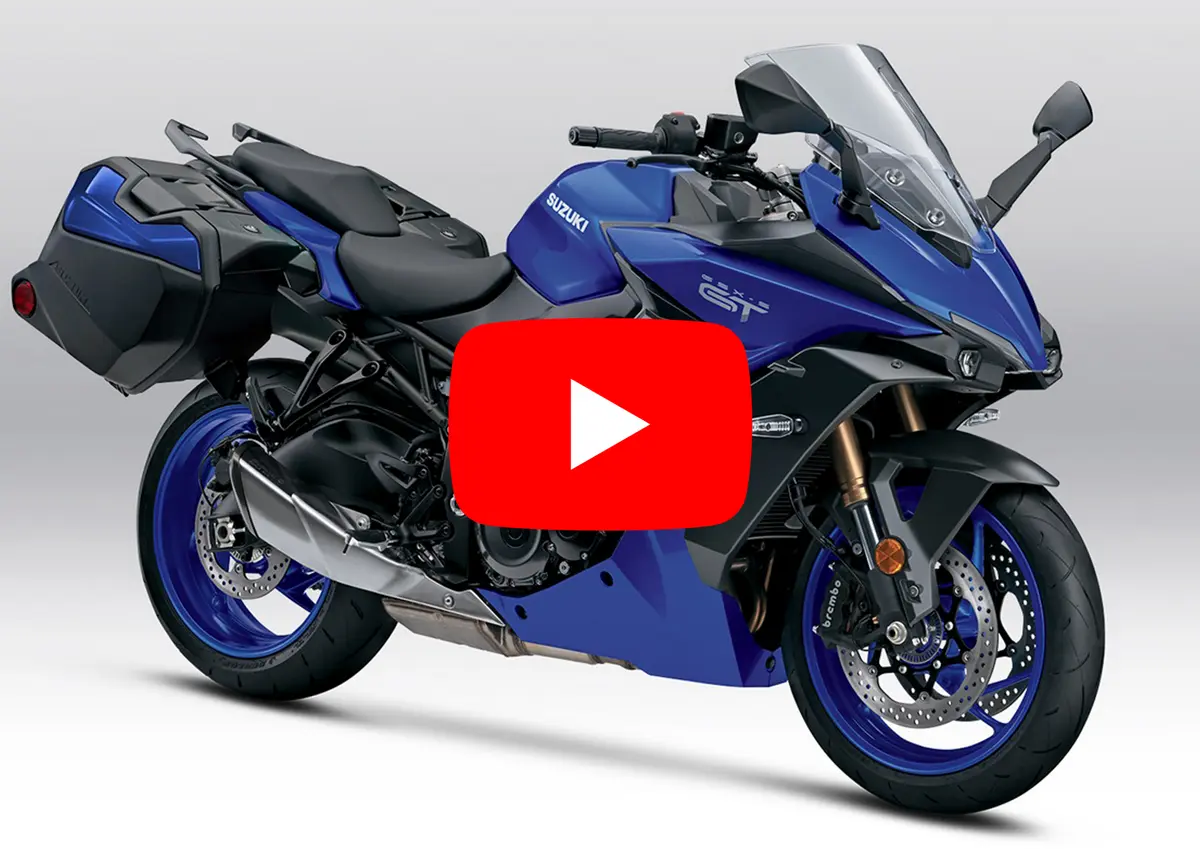
Suzuki GSX-S1000GT+ Video Review


JoomShopping Download & Support