1. How often do you need to change the motor oil and filter, and what is “synthetics” vs “semi-synthetics”?
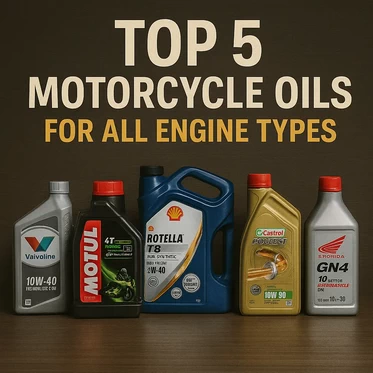
Replacing motor oil — is the key to long engine life. In most road motorcycles, it is performed every 5000–10,000 km or once a season (depending on operating conditions). Motorcycle grease performs three functions at the same time — lubricates the engine, clutch and gearbox, so it is forbidden to use car oils.
Lubricants marked JASO MA or MA2 are recommended. “Synthetics” tolerates high temperatures and loads better (relevant for sports and liter engines), while “semi-synthetics” is suitable for a calm urban regime. The oil filter is changed during each oil change.
2. How often do you need to check or adjust valve gaps?
Valve adjustment is necessary for stable power and durability of timing. Usually the interval is 15,000–40,000 km, depending on the design (chain or gear drive, number of valves).
A gap that is too small leads to overheating and burning of the valves, and too large — to metal knocking and loss of compression. The procedure requires accuracy, so it is better to perform it in a service center.
3. How often to change spark plugs and air filter?
Spark plugs are replaced every 15,000–20,000 km, iridium can last up to 30,000 km. Contaminated or worn candles cause increased fuel consumption, poor starting and unstable idling.
The air filter is checked every 10,000–15,000 km or more often when driving on dusty roads. The contaminated filter limits the air supply, impoverishes the mixture and reduces the engine life.
4. How often should the drive chain be cleaned and lubricated?
The optimal interval is — every 500–1000 km or after each trip in the rain. For cleaning, use special chain cleaners (chain cleaner) and a brush of the “Grunge Brush” type.
For lubrication, use motorcycle lubricants for O- or X-Ring chains — they have compositions that do not dissolve the O-rings. Lubrication is performed after the trip, when the chain is warm —, the lubricant penetrates better into the links.
5. How to correctly check the tension of the chain (slack) and how important is it?
Normal sag is 25–35 mm (for most road models). The check is performed on the central part of the chain when the bike is on wheels or a central stand.
A chain that is too tight puts an excess load on the gearbox bearings and pendulum, while a chain that is too loose causes jerks and accelerated wear of the sprockets. Always check the tension after adjusting the tensioners and fix the rear wheel axle.
6. When is the time to change the chain and stars?
The chain and stars are always changed as a set. Signs of wear: noticeable elongation (chain “hangs” even with proper tension); the teeth of the stars have become sharp or “hook-shaped”; uneven pitch when rotating the rear wheel.
Usually the kit serves 20,000–30,000 km, but the term depends on the power of the motorcycle, the quality of care and operating conditions.
7. What is Slipper Clutch and how does it affect service?
Slipper Clutch (anti-skid clutch) — system that prevents the rear wheel from locking during a sharp gear reduction. It relieves the gearbox and increases stability at the entrance to the turn.
In terms of service, “slipper” does not require separate procedures, but it is sensitive to the quality of the lubricant. Therefore, it is important to use JASO MA2 motorcycle oil, which ensures proper friction between the discs.
8. How to determine that clutch discs need to be replaced?
The main sign of — slippage at a sharp acceleration, when the revolutions grow and the speed of — does not. Also, pay attention to the difficult switching or burning of the smell of the lubricant.
Discs (friction and steel) must be changed as a set, and springs — must be tested for length. In wet grip (the most common type), lubricant replacement often solves the problem of short-term slippage if the discs are not already worn.
9. Do I need to change the lubricant in the gearbox on wet crankcase motorcycles?
In most modern 4-stroke motorcycles, the engine, clutch and box use the same lubricant. Therefore, the replacement is carried out simultaneously with the planned replacement of engine oil.
If the box has a separate oil system (rare —, for example, in some old or cross models), the lubricant is changed according to the — regulation approximately every 10,000 km.
Advice from an expert: regular maintenance of the chain, inspection of valve clearances and timely replacement of lubricant extend the life of the engine and transmission by half. A motorcycle with a well-maintained chain and proper clutch operation not only works smoother, but also maintains the accuracy of gear shifting even after tens of thousands of kilometers.